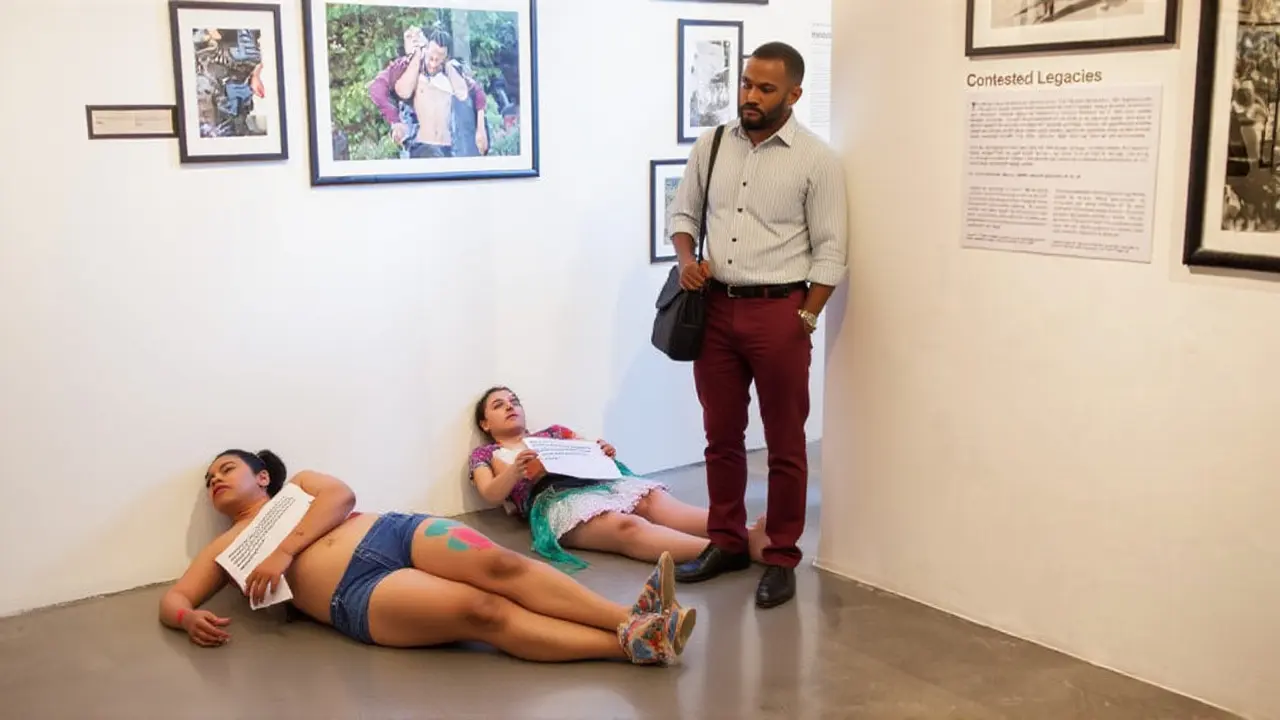
It’s a strange twist of irony. A year after University of Cape Town (UCT) finally removed the statue of Cecil John Rhodes, students aligned with the very movement that demanded its removal turned their attention to art galleries and residential halls. On March 10, 2016, protesters associated with the Rhodes Must FallCape Town movement vandalized an exhibition at the Centre for African Studies Gallery, smearing photographs with red paint and blocking entrances with their naked, painted bodies.
Here’s the thing: this wasn’t random vandalism. It was a calculated act of symbolic violence aimed at what activists called "images of oppressors." The incident highlights the ongoing, often chaotic struggle over how post-apartheid South Africa remembers its colonial past. While the statue is gone, the debate over institutional memory has only intensified.
The Protest Unfolds
The scene at the Centre for African Studies Gallery on UCT’s upper campus was striking. According to reports from The South African, students didn't just shout slogans; they used their bodies as barricades. They smeared red paint across photographic images displayed in the gallery, effectively defacing the artwork before physically obstructing access to the space.
But the action didn't stop at the gallery doors. Activists also targeted student residences. Artworks were removed and burnt from Fuller Hall, Smuts Hall, and Jameson Hall. The justification provided by the protesters was clear: they were ridding the university of symbols they viewed as perpetuating colonial oppression. It’s a stark reminder that for many students, the physical removal of a bronze statue was just the beginning, not the end, of the fight.
From Statue to Systemic Change
To understand why this happened in March 2016, you have to look back to March 2015. The Rhodes Must Fall movement began when student activist Chumani Maxwele hurled excrement at the Rhodes statue on March 9, 2015. That shocking act sparked month-long protests that became some of the largest student demonstrations in South Africa since the end of apartheid.
By April 9, 2015, the statue was gone. But the movement evolved. It shifted from a single symbol to a broader critique of institutional racism, curriculum decolonization, and the lingering presence of colonial imagery in everyday campus life. The 2016 vandalism was part of this second wave—targeting less visible but equally potent symbols in residence halls and academic spaces.
Why This Matters Now
Fast forward to 2025. On April 9, 2025, UCT marked the 10th anniversary of the statue’s removal with a symposium titled "Reflecting on #RhodesMustFall: Ten years on" held at the very same Centre for African Studies Gallery where the 2016 vandalism occurred. The fact that the university chose this specific location for reflection underscores the deep scars and complex legacy of these events.
The vandalism of 2016 remains a contentious chapter. For critics, it represented destructive vigilantism. For supporters, it was a necessary disruption of colonial aesthetics embedded in the university's fabric. The tension between preserving heritage and demanding decolonization continues to shape debates not just in Cape Town, but globally, influencing discussions at institutions like the University of Oxford.
Key Facts of the 2016 Incident
- Date: Around March 10-11, 2016
- Location: Centre for African Studies Gallery, Fuller Hall, Smuts Hall, and Jameson Hall at UCT
- Action: Photographs smeared with red paint; artworks removed and burnt; gallery entrances blocked by protesters.
- Motive: To remove "images of oppressors" and continue the decolonization process started by the statue's removal.
- Context: Occurred one year after the start of the Rhodes Must Fall movement and less than a year after the statue's removal.
Frequently Asked Questions
What exactly did the protesters do at the Centre for African Studies Gallery?
Protesters smeared red paint over photographs in the exhibition and blocked the gallery entrances using their naked, painted bodies. This performance-style protest was designed to physically obstruct access while visually marking the space as contested territory against colonial narratives.
Why were artworks burnt in the residence halls?
Activists removed and burnt artworks from Fuller Hall, Smuts Hall, and Jameson Hall because they viewed these pieces as "images of oppressors." The goal was to extend the decolonization effort beyond the main campus statue into the daily living spaces of students, challenging the pervasive presence of colonial iconography.
How does this relate to the original Rhodes Must Fall movement?
The 2016 incidents were a continuation of the movement that began in March 2015 with Chumani Maxwele’s protest. While the initial focus was removing Cecil John Rhodes’ statue, the movement broadened to address systemic institutional racism and colonial symbols throughout the university, including art and architecture.
Did the university take legal action against the vandals?
Available records do not specify immediate legal prosecutions or disciplinary actions taken against the individual students involved in the 2016 vandalism. The focus of public discourse has largely remained on the political and symbolic implications of the acts rather than criminal proceedings.
What is happening at UCT today regarding this history?
In April 2025, UCT hosted a symposium at the Centre for African Studies Gallery to mark the 10th anniversary of the statue's removal. This event signals an ongoing institutional effort to reflect on the legacy of Rhodes Must Fall, acknowledging both the progress made and the continuing tensions around decolonization.
Shreyanshu Singh
May 24, 2026 AT 01:39bro really thought painting red on photos was gonna fix systemic racism lol. its just performative chaos at this point. the whole 'decolonization' narrative is just a excuse for vandalism and entitlement. nobody cares about your feelings when you destroy property that isn't yours to judge. it's pathetic honestly.
Sohni Bhatt
May 24, 2026 AT 11:32It is absolutely disheartening to witness the intellectual decay of modern academia where brute force replaces dialectic discourse. The students in question demonstrate a profound lack of historical nuance, reducing complex colonial legacies to simplistic binaries of oppressor and oppressed. One must ask if the removal of statues truly addresses the structural inequities they claim to fight or merely serves as a cathartic ritual for those unwilling to engage with the tedious work of policy reform. The burning of artworks in residence halls is not liberation; it is barbarism disguised as progress. We are witnessing the erosion of civil society under the guise of moral superiority. It is imperative that we do not conflate destruction with decolonization. The true elitism lies in assuming one can erase history without understanding it. This behavior reflects a dangerous trend where emotion dictates action rather than reason. Society will pay a steep price for this abandonment of rationality. Let us hope future generations learn from these mistakes before the fabric of our institutions unravels completely into anarchy.
Prashant Sharma
May 25, 2026 AT 22:15One might argue that the act of defacement is itself a form of art, albeit crude. However, I find myself compelled to disagree with the notion that violence against objects constitutes meaningful political change. It is merely symbolic posturing. The real issue is the curriculum, not the paint on the wall. Yet here we are, focusing on the spectacle. How quaint.
Mike Gill
May 26, 2026 AT 01:12i think we need to understand why they felt so much anger though. its not just about being bad people. they were probably hurting and feeling left out. maybe if the university listened more things would be different. i hope everyone finds peace soon.
Suresh Kumar
May 27, 2026 AT 20:15The statue was never the problem. The problem is the mind that needs a statue to feel oppressed. Silence is louder than paint.
Jay Patel
May 28, 2026 AT 23:46Oh my god 🤯 can we talk about how dramatic this all is? It’s like watching a soap opera but with higher education stakes. These students are literally rewriting history with their bare hands and some cheap red paint 🎨. It’s tragic yet fascinating. They think they’re heroes but they’re just creating a mess for the cleaning staff 😩. The universe has a twisted sense of humor. Decolonize your mind first, please! 🧠✨
harsh gupta
May 29, 2026 AT 05:00Don’t fall for the media spin. This wasn’t spontaneous student activism. It was orchestrated by foreign NGOs looking to destabilize South African institutions. The red paint? A signal. The naked bodies? Ritualistic symbolism designed to confuse the public. Wake up sheeple. They want you angry so you don’t notice who’s really pulling the strings.
Mukesh Katira
May 30, 2026 AT 14:52It is morally indefensible to destroy cultural artifacts regardless of the intent. There is no justification for such actions. Respect for property is fundamental to any civilized society. We must uphold these standards firmly.
Roop Kaur
June 1, 2026 AT 01:18Look at the paradigm shift happening here. It’s not just vandalism, it’s a deconstruction of hegemonic visual narratives. The epistemological violence of the gallery space is being challenged through corporeal resistance. But also, did anyone see the paint color? It was super bright. Very chaotic energy. Trust me, the system is rigged against them. Big Museum is watching.
Ankita Bajaj
June 2, 2026 AT 20:47Let’s focus on the positive outcome! Ten years later, they’re having a symposium to reflect. That shows growth! Instead of fighting, let’s celebrate the dialogue. We can all learn from each other. Keep pushing forward with love and respect! 💪❤️